The road from Uluru to Cairns – or in our minds from the outback to the ocean – stretches over 2.800km. It took us five days and reminded us of our sailing voyage down the Malacca Strait. A daily rhythm, enjoying the moment and keep on moving until you get there. Sailing through the outback! ⛵️ Perhaps a little far-fetched, although Kempie – our campervan – actually do catches a lot of wind.
Half way two options appear. First North, then East or East, then North. Finding your way in the outback is super easy! 🙂 The lady at the visitors centre reassured us that both options are sealed and of good quality. Well… if a road that is sort of one-way sealed and full of bumps and holes is considered to be of good quality, we for sure will skip the bad quality roads. Luckily, Kempie couldn’t care less and brought us safely to Cairns.
Arriving in Cairns from the outback is like arriving in paradise. All of a sudden you’re welcomed by hills covered by green grass, beautiful trees and flowers, followed by a dense rain forest and finally the ocean. We made it! 💪🏻😍 Although, we had to let it pass as crocs, sharks and jellyfish rule the shoreline.
Cairns is a vibrant city best enjoyed outdoors. A croc-and-jellyfish-free swimming lagoon at the beach, an esplanada full of free sport facilities, public barbecue kitchens and plenty of restaurants and bars. On top, Cairns is the perfect getaway to explore the Great Barrier Reef. One that’s high on our bucket list!
The Great Barrier Reef is composed and built by billions of tiny coral polyps (sort of upside-down jellyfish sticked to a smooth surface) making it the biggest living thing on our planet AND visible from outer space. Well done tiny polyps! The reef is the size of Japan, home to countless of species and an incredible rich eco-system.
Unfortunately, the reef declines at an alarming rate, due to pollution, extreme weather events, starfish outbreaks and global warming. Therefore, it’s worthwhile to wonder if visiting the reef is a good thing or not. Every single year over 2 million people visit the reef! That’s loads and loads of people… but maybe it is a good thing… Every visitor pays the reef tax, which is used to conserve the reef and everyone gets briefed before entering the water. 🤔🤔🤔
The next question is which tour operator to choose. There are plenty of options and prices rate from expensive to more expensive and incredible expensive. The idea of researching the best way to explore the reef gave us a headache. Until we arrived at the campsite where a guy invited us to a reef info session and we ended up winning the price draw: a ticket to the reef!! 🥳 Lucky us!! 🥳 No research needed, half the price and just say yes. 🙌🏻😃
The briefing on the boat was so much better than our experiences in Central America and Asia. The crew tells you all about the reef, how special it is, what to do to protect the reef and for newbies they explain how to snorkel. We’ve never seen that. It’s always “here is your gear, there is the water”. They also offer free reef-safe sunscreen, floating materials and support for those who are not strong swimmers. Above all, the crew makes it very very clear not to touch anything. In fact, they will scream at you, yell at you and drag you out of the water immediately if you do so.
At the first location we opted for a scuba dive for our first Great Barrier Reef experience, which was indeed a little barrier. Bit of a personal story… I used to be an avid scuba diver and jumped under water almost every week. Yes, in The Netherlands where a dive means no more than a few meters visibility, hardly any fish and getting very cold, despite my 6mm semi-dry suit, cap, gloves, shoes, the whole thing…. don’t ask me why but I loved it.
On my way to become a Divemaster, something snapped inside me and I stopped diving until today. Was it because I became more aware of the risks during the course and noticed too many unsafe situations or did I simply got tired of fellow divers bragging about who spotted the biggest fish and used least of their air? I also realized more and more how special the underwater world is and that we – as humans – actually don’t belong there.
It’s now 7 years later, and I think we do belong there. Partly! We own enough physical elements in our body that are truly handy when free diving. Our lungs fill with blood when the pressure becomes too high to avoid a collapse, when we have a black-out our throat closes automatically to avoid we drown and with practice we can hold our breath quite a while. In fact, the Bajau people (North Sulawesi) have evolved differently for a life at the sea. Their spleen is enlarged allowing them to stay under water longer.
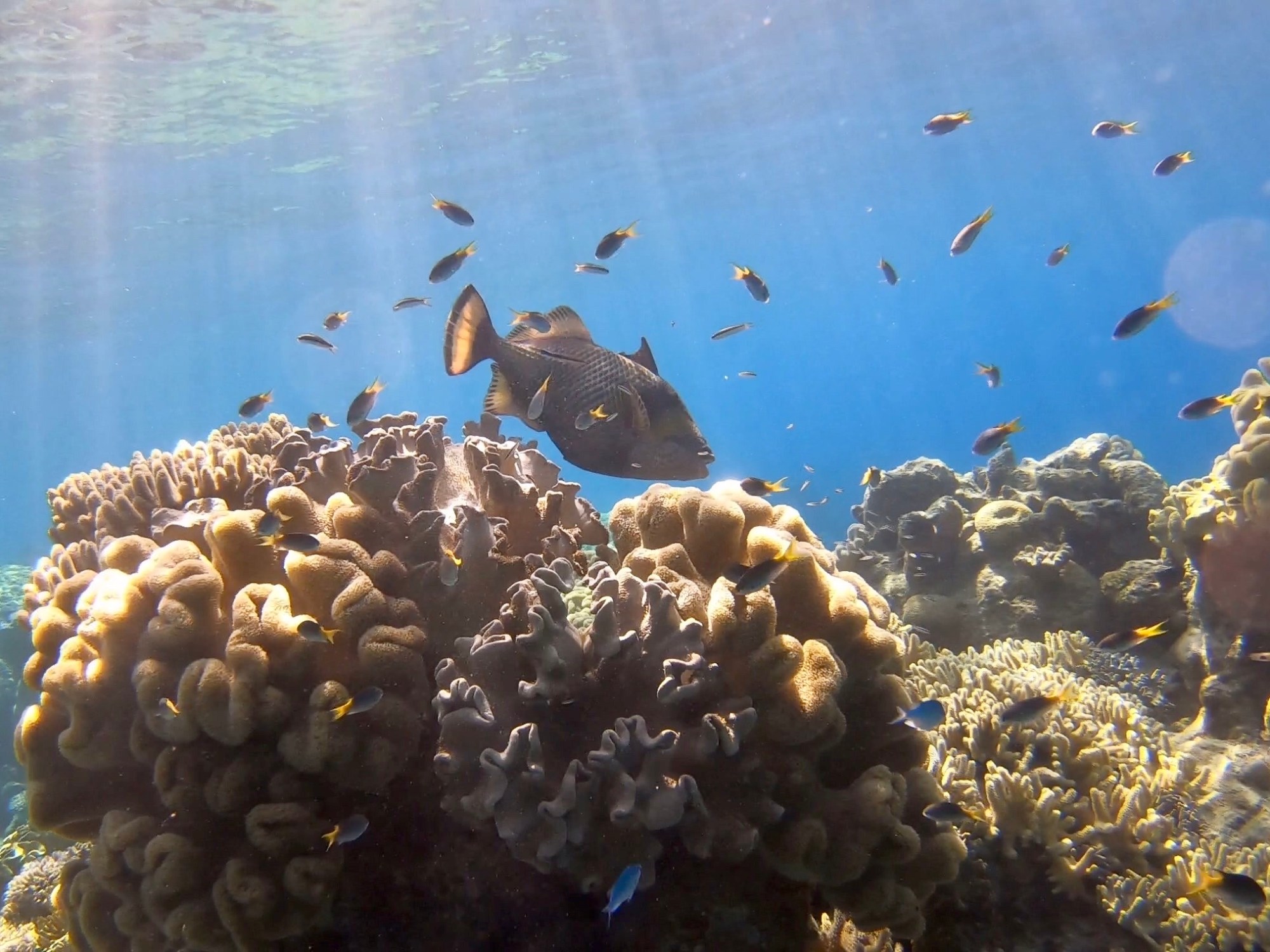
But long story short: the Great Barrier Reef was excited enough to put on scuba dive equipment again. It was wonderful. The diving itself came back in no time. Breath in, breath out and float neutral. So relaxed, so zen, while being entertained by corals, fish and reef sharks. 🐙🐡🐠🦑🐟🐳🐬🦈 So much to look at. Seriously fantastic.


At the second location we put in practice our just learned free dive techniques and learned more about the underworld from a marine biologist. Fish are so cool. Take Nemo. (and close your eyes if you’re Nemo’s biggest fan). His dad, Marlin, was not fully honest. In a clown fish family, the biggest fish is always a female, the next biggest fish is her mate. The rest are guys. If mum dies, the biggest guy changes into a female taking over her role and so, Marlin should have told Nemo, he is his new mummie. Amazing isn’t it? And what to think about the blue lashed butterfly fish. They live in pairs happily ever after. When one dies, the other commits suicide. That’s love! 💙 And the cuttle fish, they have three hearts and blue-green blood. Or the sea cucumber, one of the most underrated animals on the planet, while they are the vacuum cleaners of the ocean! 💪🏻 Fascinating facts are there to learn about fish. We love it.


<< Long QuickStory Reef Experience >>
The Great Barrier Reef, what an unbelievable great experience. Organized, insightful and oh so beautiful! And we only saw a tiny little spot.
Thank you planet Earth. 🌏🌍🌎🙏🏻🙏🏻🙏🏻

 We around the world