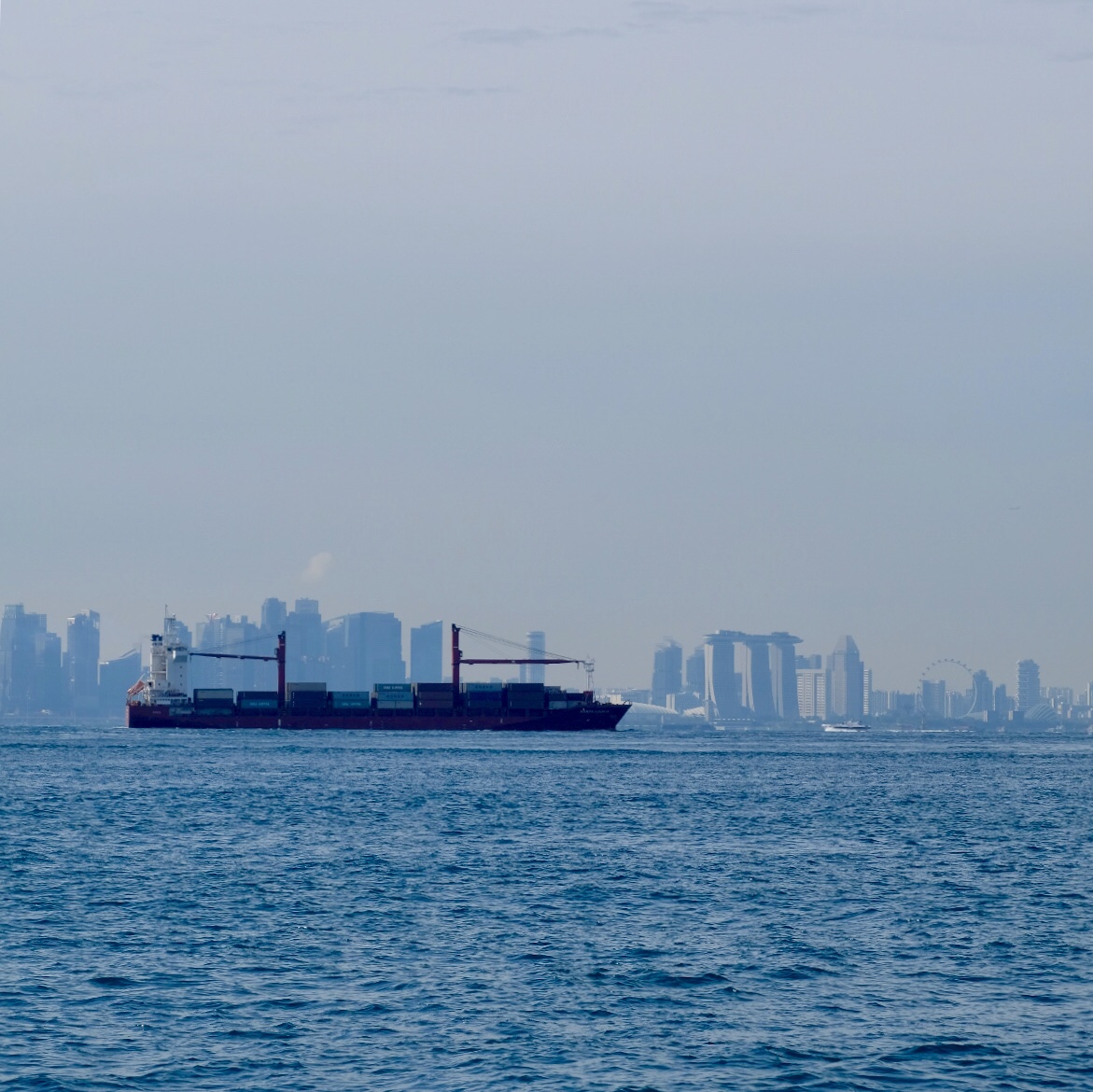
When you think of the Singapore Strait you think of ships. Big ships. We can confirm it’s true. The strait is 100 km long and 16 km wide and on a daily basis roughly 2.000 ships traverse the strait. Our aim was to cross the so-called TSS (Traffic Separation Scheme) – a high way for ships – to Indonesia, pass Singapore, cross the TSS again and go back to Malaysia along the Singapore skyline without hitting anything.
Why? Well, our instructor mentioned that any rational thinking person would never take a bunch of students on a 42-foot sailing vessel to circle around the Singapore Strait. Particular not students who have been hanging around in Thailand and Langkawi, where fast ferries ignore the rules and fishing boats are lit up like Christmas trees. (Except for one, he configured his lights as a minesweeper 🙄.). We’ve been sailing in an area where no one really seems to apply to the rules. And still he brought us to Singapore (or maybe that’s why). And why not? It is afterall one of the best places on earth to test your knowledge of the International Regulations for Preventing Collisions at Sea. 🤓
Soon we learned it’s not that difficult. Yes, these ships are big, yes there are a lot of them and yes their speed is fast. Up to four times faster than us, And still there is time to figure out a plan. It’s a matter of keeping your eyes open and thinking ahead. It’s sort of a hunting game. “Look, a ship” What type? Is it making way? Which way? Is there a risk of collision? Who has priority? How we give way? Et voilà, problem solved. “There, another ship”, etc.


The Singapore police played a similar game and were hunting us. We had just crossed the TSS for the second time, with an amazing sunset behind the Singapore skyline, when they came over to have a look. They blinded us with their lights and tried to have a conversation over the sound of the engines. “Where are you going?” “Malaysia!” “What?” “Malaysia!!” “Change course!” “Singapore border! “Marine base, there!”. We were officially in Malay waters, but we couldn’t agree more that it’s a bit strange to sail with three Englishmen, two Dutch, a Scottish and a Russian around Singapore and back for no real reason. “For the experience” did not sounded like a solid reason they would accept. To avoid any trouble we decided to stay for the night on the East side of Singapore on Malay grounds. Not a punishment at all. A shower, a good night sleep and a swimming pool. 👌


On the next tidal flow – the next evening – we went back to the West side. This time the police chose a more effective communication method and via the marine radio we were kindly ask to change course a little bit more to be a little bit further away from Singaporean waters. The trick to pass Singapore in a small vessel is to stay in a small stretch of water between the TSS – where the big ships pass at a high speed and where we don’t want to be – and the Singaporean border, where the police patrols and where they don’t want us to be. The border is no more than a line on the chart. You can’t actually see it, although the police makes sure you know where it is. The police tracked us carefully all the way. Each time their lights came closer, we hoped our navigation was still correct.
Meanwhile we continued our ‘spotting-ships-hunting-game’. Spotting lights in the dark is even more fun. This is a snap-shot of a random conversation between two crew members at night at the Singapore Strait: “Light on your starboard bow” “Which one, the isolated danger mark or the other one?” “The other one.” “What is it? Is it moving?” “Not sure.” Binocular. “It’s three white lights.” “So, a tug and tow, more than 200 meters.” “Yep” “Which way?” “Red, port” “Ok… better take a bearing” “089” “Another ship more than 50 meters on our port. Going parallel” “Ok” BEEEEEE. (Horn sound). “It will turn to starboard, I’ll give way.” “Bearing now 105. We’re safe.” “There, another ship to keep an eye on”, “It’s anchored, I see two anchor lights.” “Good.” “Shall I make coffee?”. When I was young I wanted to become an air traffic controller. I guess I made it sort of afterall 😇. We really enjoyed it but ok… we agree it’s crazy talk if you really think of it … 🙃


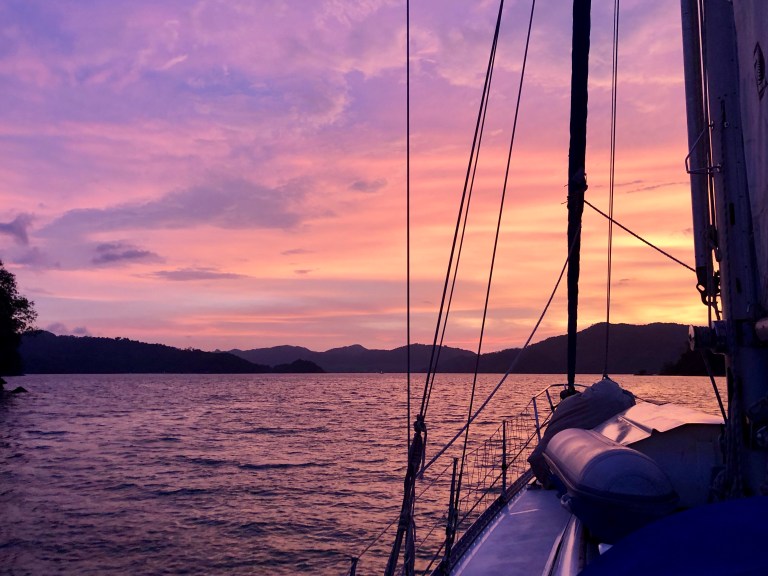
Actually, this whole sailing fuss is a bit “pathetic”. 🤪 One evening in Malacca we were hanging out on a terrace at a Dutch canal. (Just like home 🙂). Towards the end of the evening we realized we’ve been talking about sailing all evening long. To top it off we all had a sunset sailing wallpaper on our mobile… 😂 We’re just saying, be careful if you ever consider sailing. It can hit you. 😉
Anyway. The Singapore Strait was another incredible sailing experience. A special experience. The moment we saw the famous skyline from the water, it felt like another milestone during our world trip. Who would have thought we would come back to Singapore. By boat, nonetheless!
We had a chance to visit Singapore for the weekend. For us it was a trip down the memory lane: eat Murtabak, Arab street, Marina Bay Sands picture moment, stroll around Suntec City, beer at Blu Jaz and more important: to do our laundry.


It was good to take a step back from sailing. A fast-track course is pretty intense. And so on our way back over the Malacca Strait to Langkawi we did it again, and again and again. In Kukup we ate ashore in a small fishing village where time stood still. A complete different world, just 25 miles outside modern Singapore. In historical Malacca we strolled in between the colonial buildings and in vibrant George Town we… 🤔… we simply had a good time.


The trip itself progressed smoothly. Neptune was kind to us and the only rather weird moment was our ‘less water’ experience.
It was one of those beautiful nights with a starry sky, wind in the sails and all running as per plan. Until, the depth control showed five meters. Hmm, five meters? According to the chart it should be ten. That said, if our position is correct. Five meters meant we’re close to shallow water and in a position where our sleeping skipper did not wanted to be. A double check on the electronic chart plotter confirmed the same position and a depth of ten meters. Navionics (online navigation app) also agreed. “So why do we have five meters under the keel!?!” … “A dolphin? 😍“
No such luck, it turned out to be ‘less water’. The small print on the chart, no-one spotted, explains there is less water in this area. “Less water?!? Come on, are they serious? How come there is less water? They mean a pothole in the water, or what? Less water… how much less?!?” Really, really brilliant, the charts in this area of the world. Theory and practice are often miles apart. 🙄
23 Days after we left Langkawi, we arrived back. It was an amazing and valuable experience. We are exhausted and satisfied and the best news? We still have a sunset sailing picture as a wallpaper. 😍 One more week to go! Exam time! 😱🤞🏻

 We around the world